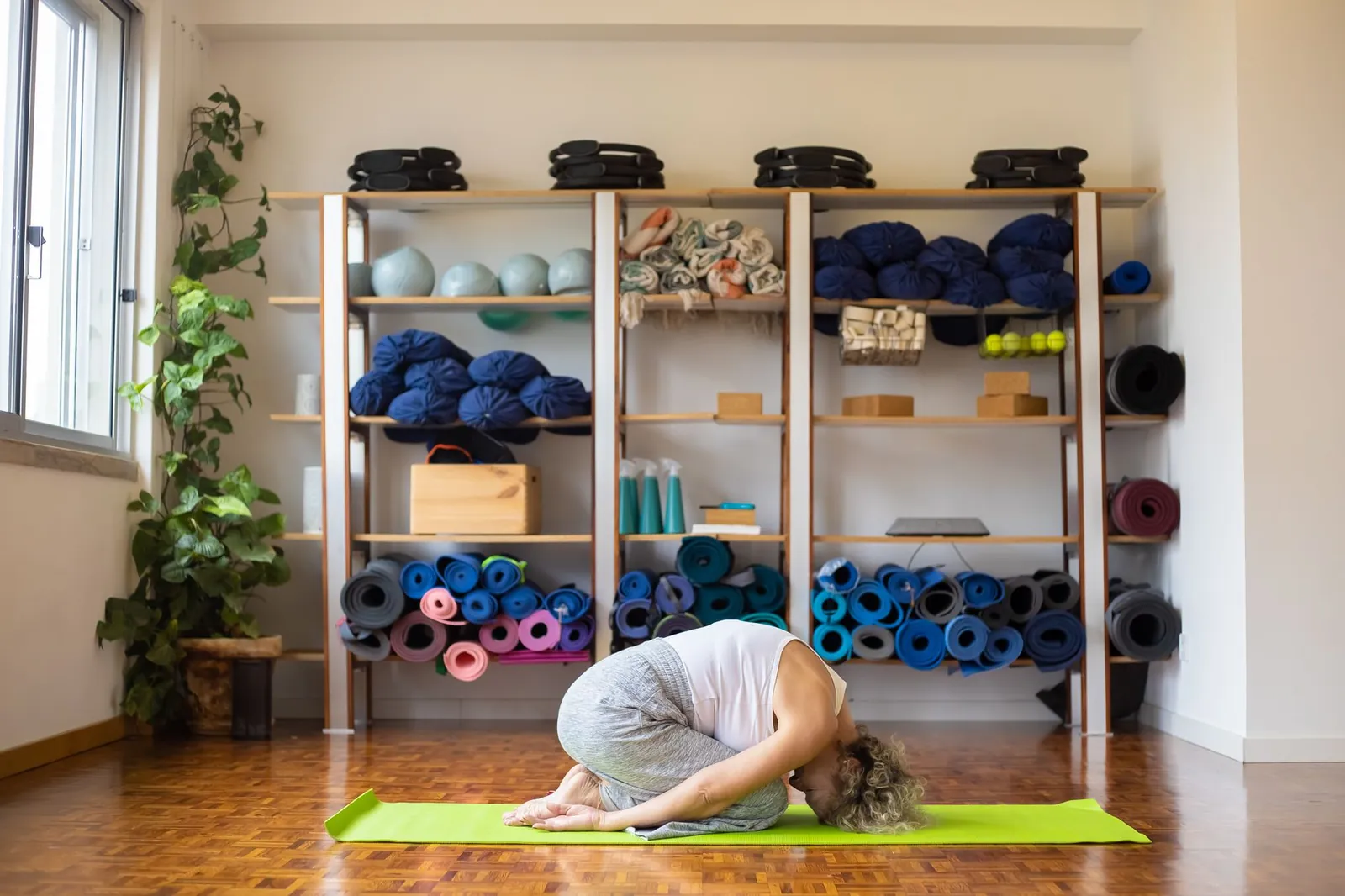
The first time you lead a restorative class, you will notice how quiet the room gets and assume you did something wrong. Someone will close their eyes during the second shape, and part of you will take it personally. It is not a verdict. A restorative class is supposed to feel almost empty of instruction, and that emptiness is the assignment. You are not running a workout. You are arranging conditions so another person can stop holding themselves up.
Start with the props
The clearest signal of what kind of class you are teaching is the array of support at the front of the room: blankets, bolsters, blocks. These are not decoration. When you stack them, you take weight off a joint and let a student hold a shape for minutes instead of seconds. A folded blanket under the knees in Supine Bound Angle Pose, a bolster under the heart to lift the chest in Supported Bridge, blocks under the shoulders in a supported shoulderstand. When a student says a prop feels like too much, try less height before deciding they do not need it.
Set the intention before the pose list
Write one sentence about what the class should do: settle the nervous system, open the hips without effort, rest. Then every shape has a job. Sequencing is deciding an arc and a direction: a few waking, upright minutes at the start, one or two longer floor shapes in the middle, roughly ten minutes of supported stillness at the end. Flat classes are the common failure, an hour of long holds from the first breath, where people tense up instead of letting go. Give your class a beginning, a middle, and a genuine ending.
Use anatomical words as instructions, not as authority
Direction cues help when they help a body find itself: rotate the upper arm outward, let the top of the pelvis soften toward the floor. Skip them when they only make a beginner second-guess their body. Your own hands make a better teacher than vocabulary. Put your palm on your hip and say "this way." You can teach a shape without naming every muscle in it.
Say less, offer choices
Restorative classes live in the quiet parts, and beginners tend to fill them. Resist it. Offer the same shape with two blankets or with none, out loud, so nobody has to ask for what they need in front of the group. Silence in the room is not a breakdown. It is the class working.
Build the class once in the online sequence builder, draft the arc, and note the props each shape needs so you are not sorting bolsters mid-pose. New issues of our newsletter publish on the site each month, with one sequence broken down shape by shape, including which supports to set out and in what order. Start with ten minutes. Teach that until it feels easy, then lengthen it.