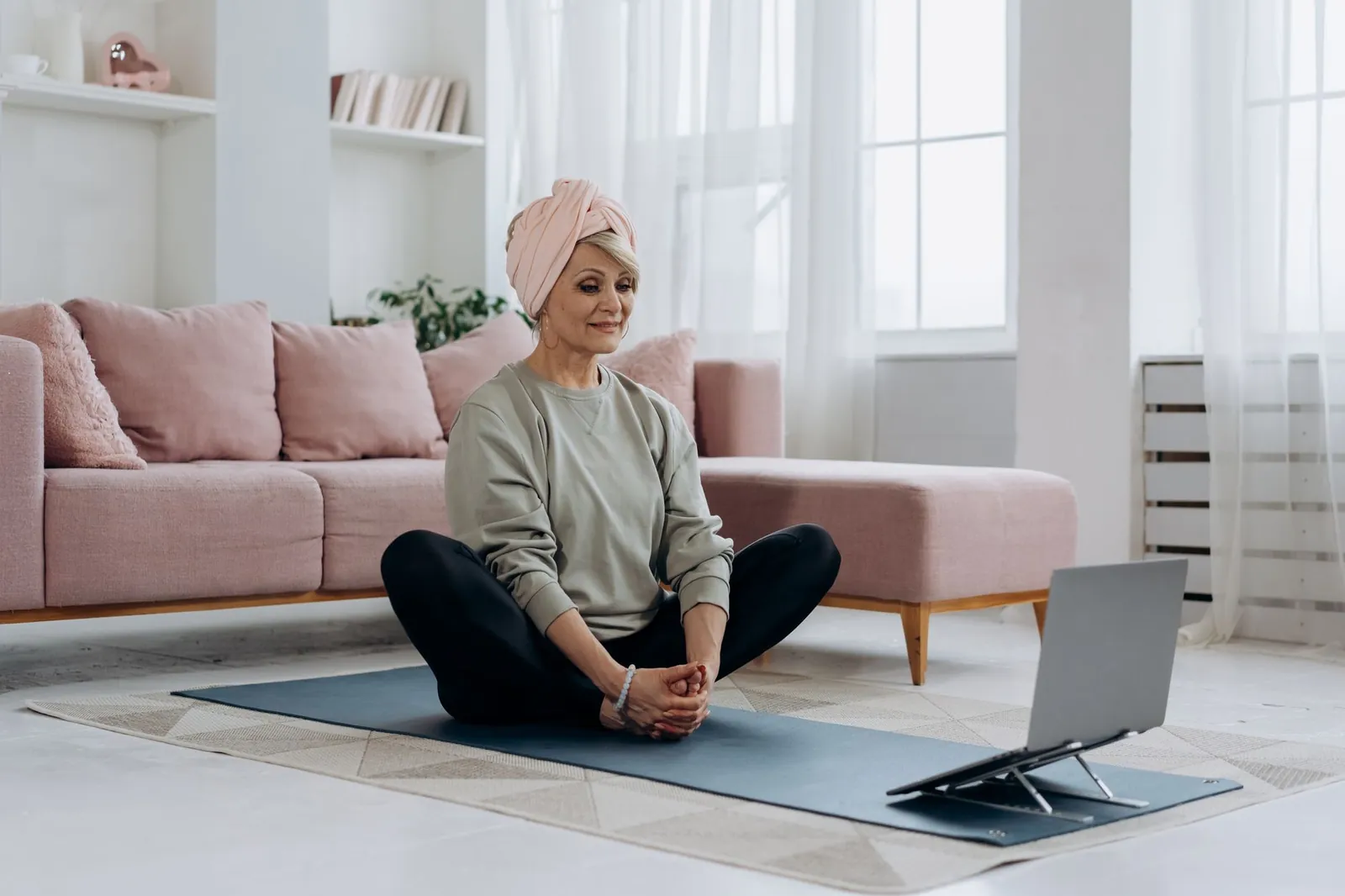
Imagine rolling out your mat in your living room, cueing up a session, and having a calm voice walk you through Warrior II, then gently correct the angle of your front knee — without anyone else in the room. That's the promise behind AI-guided yoga, and for many home practitioners it sounds like a quiet kind of miracle. Before you download the first app that promises one, it's worth slowing down and asking a more grounded question: what does this technology actually do well, and where does it fall short of a real teacher?
The first thing to understand is that an AI instructor works from visual analysis. Using your phone or laptop camera, the software maps your body's key points — shoulders, hips, ankles, the line of your spine — and compares them against a reference model for the pose. When your front knee drifts past your ankle in Warrior II, or your hips are uneven in downward dog, the screen flags it and asks you to adjust. That's genuinely useful for a beginner practicing alone, because the most common cause of bad form is simply not knowing what your body is doing when no one is watching.
A second point: the experience is at its strongest with the foundational poses. Sun salutations, standing poses, and the basic seated stretches are well-represented in training data, which means corrections tend to be accurate and timely. The moment you move into more subtle work — a deep backbend, a binding variation, or a restorative shape held for several minutes — the visual analysis gets less reliable. Subtle alignment shifts in the spine or shoulders don't always read clearly to a camera, and breath cues are essentially absent. If your home practice is mostly vinyasa flow and gentle stretching, you'll get a lot out of it. If you're working toward intermediate poses or holding long restorative holds, you'll start to feel the ceiling.
A third point worth holding onto: an AI instructor doesn't replace a teacher's eye, but it does replace the moment of wondering, mid-practice, whether you're doing the pose at all. For someone building a daily habit, that quiet feedback loop — small correction, small improvement, small confidence — is often the difference between a mat that stays rolled up and a practice that lasts. Used a few times a week alongside the in-studio experience we offer here in Colorado Springs, it can be a real bridge between sessions.
If you're curious how this might fit into your own routine, our online sequence builder lets you design a short home flow using poses you already know, so you can spend less time scrolling and more time on the mat. And when you want the real thing — hands-on adjustments, breath cues, and a teacher who sees the whole shape of you — our Colorado Springs studio is open and welcoming.